Teaching Puppy Alone Time: Start Smaller Than a Departure
Introduce manageable time apart with tiny practice steps, careful observation and a realistic backup-care plan.
Teaching alone time does not have to begin with leaving the house. For some puppies, the useful first step is remaining comfortable while you stand up or move a short distance away. Start with the smallest change your puppy can handle, then observe the whole response.
The goal is comfortable time apart. A longer number on a stopwatch means little if the puppy spends it distressed.
Separate early practice from existing distress
This article is for introducing manageable separations. If your dog already panics, attempts escape, injures themselves or remains persistently distressed when left, seek help from your veterinarian and an appropriately qualified behaviour professional. Repeatedly leaving them to “get used to it” is not an appropriate experiment.
Dogs Trust's separation-anxiety guidance recommends observation and support, and arranging company when a dog cannot cope alone. Quietness by itself does not establish comfort; watch posture, movement and the ability to settle.
Choose a comfortable starting setup
Use a familiar, safe area where your puppy already spends pleasant time. Meet their immediate needs first: a toilet opportunity, water and an appropriate balance of activity and rest. Check that any toy or chew is safe for the level of supervision available.
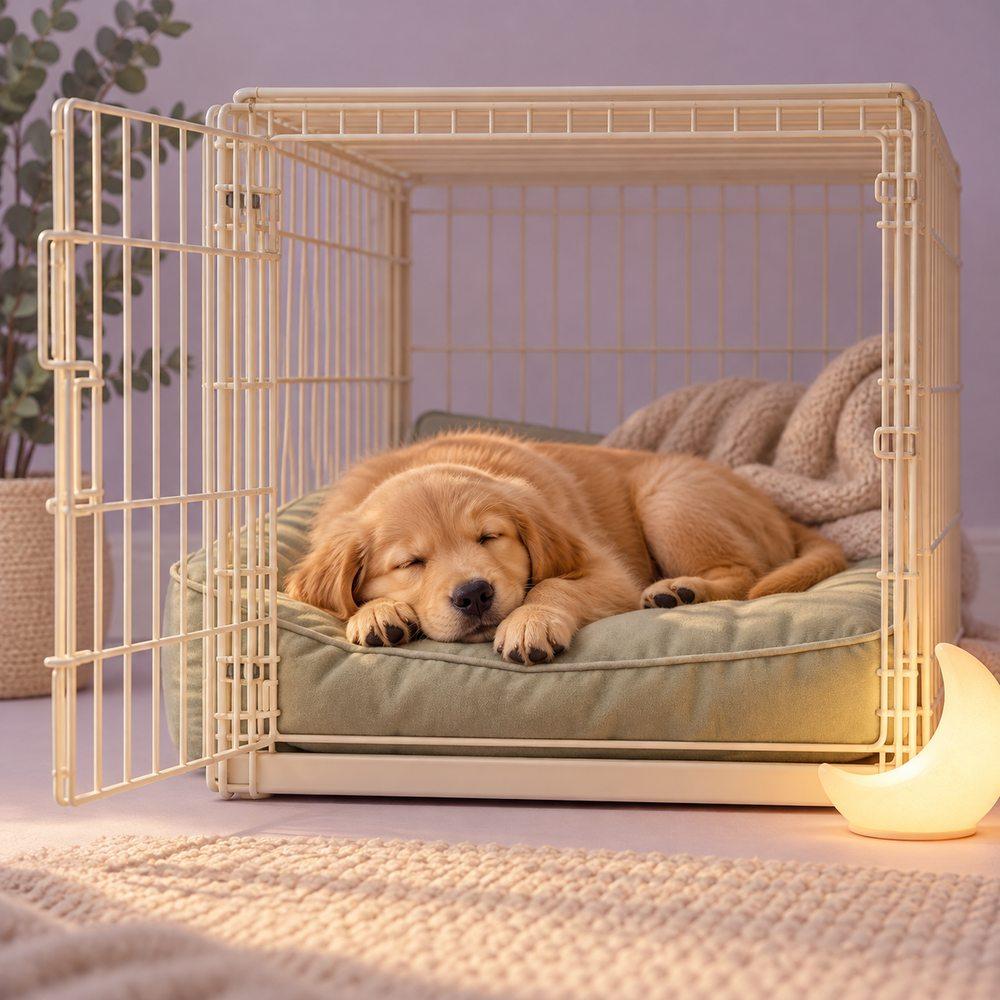
A crate is one possible setup, not a requirement. A pen or suitable room may be more comfortable. If a barrier itself is upsetting, work on that difficulty separately rather than treating every closed door as useful alone-time practice.
For a newly arrived puppy, begin with first-week routines. Familiarity with the home can give you a clearer starting point than combining a new space with a new separation.
Practise one small change
Pick a moment when the puppy is comfortable. Make a tiny movement away, then return while they remain at ease. That movement may be standing up, taking a step or briefly moving beyond a familiar barrier. Choose the step from the puppy's response, not from an online countdown.
Repeat an easy version and include breaks. Do not increase every attempt. If the puppy becomes worried, return and make the next attempt easier; do not wait for escalating distress to become silence before responding.
Dogs Trust's time-alone advice supports gradual practice and shortening separations when anxiety appears. Keep both duration and difficulty in view: a closed exterior door can be a different task from the same duration in another room.
Record comfort alongside time
Write down the setup, what you did, the puppy's response and how they behaved afterward. If you use a camera, position it to show the resting area and relevant exit rather than only a patch of floor. Keep recordings private and observe promptly enough to intervene if needed.
The 30-Day Alone-Time Ladder includes seven practice levels, a camera observation sheet and a Calm Independence Score log. These are planning tools for early skill-building, not a treatment for separation anxiety or a promise of workday readiness in thirty days.
Make a backup plan before you need a long absence
List the unavoidable absences in the coming week and arrange suitable care for time beyond what your puppy has demonstrated they can manage. Training progress and your calendar may move at different speeds. A sitter, family member or another appropriate care arrangement can keep those pressures separate.
If nighttime separation is also difficult, see crate comfort during the first nights. Daytime practice should not require enduring an overwhelming night first.
Review the plan after several ordinary sessions. Keep comfortable steps, reduce difficult ones and seek support if progress is constrained by distress. Preview the Alone-Time Ladder for a practical way to organize the observations and your return-to-work bridge plan.
Sources
PupSkills publishes educational guides for everyday training. The articles draw on the sources listed above and do not replace individual veterinary or behaviour advice. Read our editorial approach.